The State of SaaS: Yearly Review
- 4 days ago
- 6 min read

The state of SaaS in this yearly review shows an industry becoming more efficient while facing slower growth, changing customer behavior, and growing pressure from AI. Recent SaaS benchmarks reveal improvements and declines as AI reshapes how software companies build, sell, and monetize their products. Understanding these SaaS performance metrics helps leaders benchmark their business, adapt their operating model, and make better decisions for sustainable growth in the year ahead.
Every year, a new batch of numbers tells software companies how they actually performed, not how their board decks say they performed. This 2026 SaaS and AI Metrics Benchmarks review pulls from a fresh yearly SaaS review of 342 B2B SaaS and AI-native companies, and the results are more complicated than a simple "up" or "down." On paper, 2025 was a strong year for SaaS. Efficiency climbed, payback periods shortened, and profitability metrics improved across the board. But look past the headline numbers, and the data tells a second story: growth is slowing, retention is weakening, and AI is quietly rewriting the rules for how software companies price, sell, and scale.
A Year of Contradictions for the State of SaaS in 2026
By the numbers, SaaS looked healthier in 2025 than it had in years. CAC payback periods shortened from 18 months to 16, the fastest improvement in five years of benchmarking. Rule of 40 scores jumped from a median of 15% to 25%, the biggest single-year gain the industry has seen. ARR per employee rose sharply too, reflecting a wave of AI-assisted productivity across engineering and operations teams.
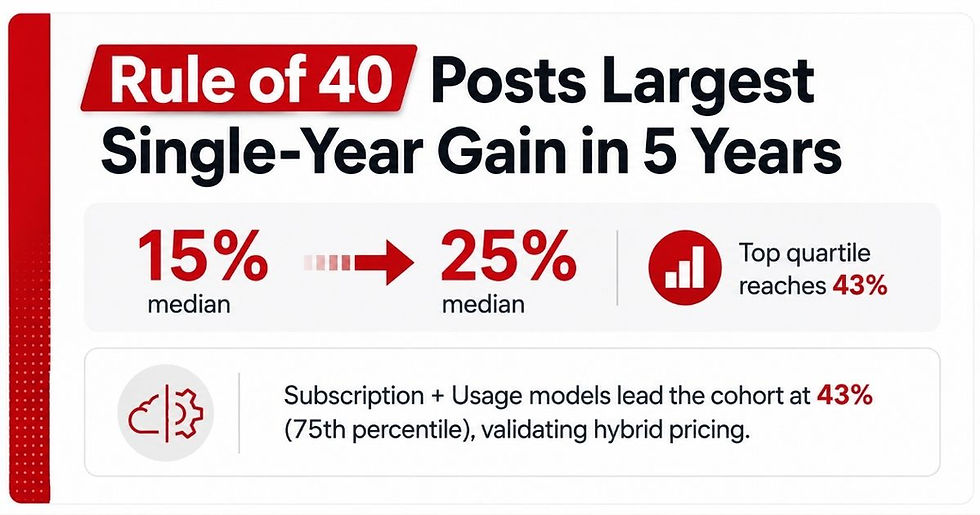
On the surface, this looks like a full recovery from the turbulence of the early 2020s. But the same benchmark data that celebrates these efficiency wins also flags a softer, more concerning trend underneath. Median revenue growth fell to 20%, continuing a four-year decline from 30% in 2022. Gross revenue retention (GRR) dropped from 88% to 84%. And seat-based companies, long the default SaaS pricing model, slipped toward the 100% net revenue retention (NRR) line for the first time.
The thread connecting all of this is AI. Not simply "AI is replacing SaaS," but something more layered: AI is reshaping what buyers expect, putting pressure on legacy pricing structures, and forcing SaaS operating model changes that most companies have only just begun to make.
Rule of 40 Explains Why the "Recovery" Comes With a Catch
The Rule of 40 has become one of the most widely cited SaaS metrics that matter, especially among investors. The formula is simple: add your revenue growth rate to your profit margin, and the total should land at 40% or higher. It exists because growth and profitability are supposed to trade off against each other. A company growing 50% a year can usually justify heavier spending, while one growing only 10% is expected to run leaner. Rule of 40 gives investors and operators a quick gut-check on whether that balance is working.
By that measure, 2025 looked like a breakthrough, with the median Rule of 40 climbing ten points. But the reason behind that jump matters more than the number itself. Much of the improvement came from cutting costs rather than growing revenue. R&D spending as a share of revenue fell from 35% to 27%, and sales and marketing budgets were trimmed as well. Companies became more efficient largely because they invested less, not because their businesses got structurally stronger.
That distinction matters because cost discipline has a ceiling. Trimming budgets can only take a company so far before it starts eating into the very functions that drive future revenue growth. A stronger Rule of 40 built on shrinking investment and softening retention isn't the same as a stronger business. Real recovery, and a healthier state of SaaS going forward, will need to come from revenue expansion, not just expense reduction.
Usage-Based vs Seat-Based Pricing is the New Fault Line
One of the clearest signals in this year's SaaS benchmarks is a widening gap between pricing models. Companies using usage-based pricing posted median NRR above 108% in 2025, while seat-based pricing companies landed at or below the breakeven line. That gap might look modest at first glance, but compounded year over year, it separates companies whose revenue expands naturally from those constantly chasing new logos just to keep ARR flat.
For most of SaaS history, seat-based pricing was the default motion, with more employees using the product meant more revenue, and account growth tracked headcount growth. AI complicates that equation. When a single employee can accomplish more with AI-assisted tools, seat count stops being a reliable stand-in for value delivered. And as AI agents begin absorbing tasks that once required additional licensed users, the traditional expansion playbook starts to break down, even when customers are still getting real value from the product.
This doesn't mean every seat-based company needs to abandon its model overnight. Usage-based pricing brings its own complexity around forecasting, margin, and buyer predictability. But the data makes one point hard to argue with: 2026 needs to be a year of genuine pricing experimentation for companies still leaning entirely on seats.
Why GRR and NRR Are Flashing Warning Signs
If there's one metric that should worry SaaS leaders most, it's the GRR. Median GRR fell to 84% in 2025, down from roughly 90% just a few years earlier. Even top-quartile performers weren't immune, with the 75th percentile slipping from 95% to 91%.
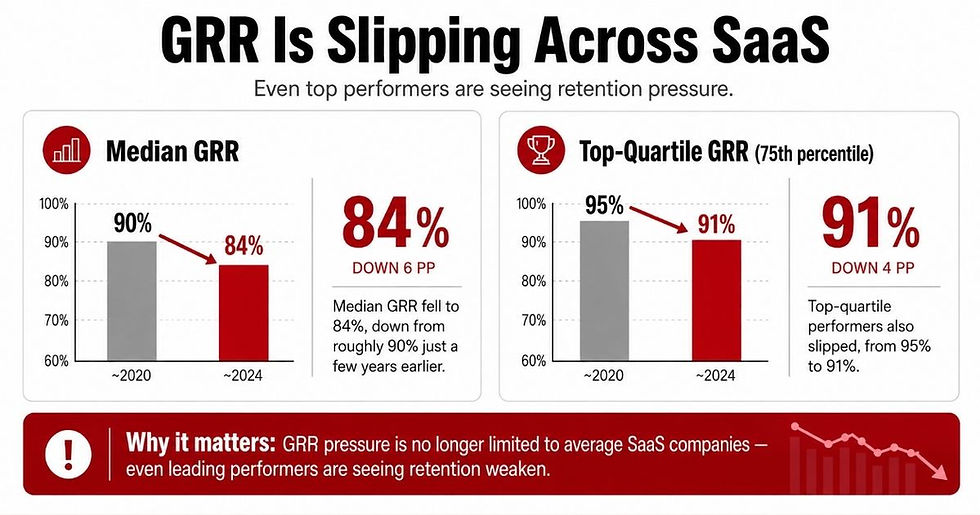
GRR matters because it can't be disguised. Expansion revenue and new logo growth can mask retention problems for a while, keeping the top line moving even as the foundation weakens. But gross retention shows whether existing customers are staying, independent of upsells or new deals. When that number moves the wrong way across an entire industry, it points to something bigger than a few underperforming customer success teams.
Buyers today are scrutinizing every renewal more closely, weighing whether their existing vendor can keep up or whether a newer, AI-native competitor might do the job better. That shift changes what customer retention actually measures. It's no longer just a customer success metric; it touches product depth, pricing alignment, and how defensible a company's workflow really is against AI-native alternatives. Reversing the trend means making the value case obvious well before renewal conversations start, not during them.
How AI Is Changing SaaS
The clearest sign of AI's impact shows up in headcount efficiency. ARR per employee rose sharply in 2025, a direct reflection of how SaaS companies are using AI to do more with smaller teams. This productivity boost also explains part of the R&D story: as AI tools took on more engineering and support work, R&D spending as a share of revenue declined even as output held steady or improved.
What's notable is how unevenly companies are capturing this dividend. The typical company puts only a small share of its R&D budget toward AI initiatives, while top-quartile performers invest several times that share. Meanwhile, software gross margins have held roughly steady, meaning the cost of AI, inference, tooling, and model subscriptions hasn't yet caught up with the productivity gains it's producing. For now, most companies are getting the upside of AI monetization in SaaS without fully paying for it.
That won't last indefinitely. The real divide forming isn't between companies that use AI and those that don't; nearly everyone does now. It's between companies banking their AI-driven savings as pure margin and those reinvesting those gains into building a durable advantage.
SaaS Metrics That Matter
The efficiency gains SaaS companies booked in 2025 are largely a one-time event. You can only cut R&D and sales and marketing spending so far before there's nothing left to trim. What happens next, how leadership teams reinvest that freed-up capital, will determine whether last year marks a genuine turning point or just a temporary bright spot.
Broadly, companies appear to be splitting into three camps. Some are simply pocketing the savings and protecting margin. Others are spreading a little AI investment around without any structural change to how the business runs. And a smaller group is using the moment to rebuild its SaaS operating model entirely, rethinking pricing, expansion, and how the finance function operates day-to-day. Early data suggests only a minority of companies are taking that third, more demanding path, even though it's the one most closely tied to top-quartile growth outcomes.
The efficiency captured last year isn't something companies simply get to keep. It's closer to a one-time budget: spend it wisely, and it becomes the foundation for a real AI-era advantage. Bank it quietly, and growth likely drifts back toward the declining median that defines most of the market right now.
Key Takeaways From This Year's State of SaaS Review
The 2025 efficiency "recovery" was real but was driven more by cost-cutting than by stronger revenue growth.
Usage-based pricing is meaningfully outperforming seat-based pricing on net revenue retention, and that gap is likely to widen as AI changes how value gets delivered.
Gross revenue retention is the metric to watch most closely heading into 2026; its decline signals deeper questions about product depth and competitive defensibility.
AI is already boosting SaaS performance metrics like ARR per employee, but the cost side hasn't caught up yet, creating a narrow window for companies to build lasting advantages.
The companies that turn last year's savings into structural change, in pricing, in expansion strategy, in how finance operates, are the ones most likely to separate from the pack in the year ahead.
The state of SaaS heading into 2026 isn't a story of crisis or celebration. It's a story of a market in transition, where the companies willing to rethink how they price, retain, and reinvest will be the ones defining what SaaS growth looks like next.